In split buying, the time cut says: if a tranche has not reached its profit target within N sessions, sell it at the close anyway.
It is a rule for locking in losses, which looks wrong at first glance. Surely waiting a bit longer would work? And indeed, removing the time cut raises returns. There is still a reason to keep it.
Changing only the time cut
Using A2 Standard and varying nothing but the time cut. SOXL 2010-03 to 2026-09, $10,000 seed.
| Time cut | Return | CAGR | Max DD | Win rate | Wins | Cuts | Avg hold |
|---|---|---|---|---|---|---|---|
| 3 | 344% | 9.5% | −20.4% | 55.4% | 1,054 | 849 | 2.6 |
| 5 | 1,546% | 18.5% | −25.1% | 68.6% | 1,306 | 597 | 3.4 |
| 7 | 5,880% | 28.2% | −33.7% | 75.4% | 1,435 | 468 | 4.0 |
| 10 (default) | 13,760% | 34.9% | −42.2% | 80.8% | 1,533 | 364 | 4.7 |
| 15 | 17,172% | 36.7% | −57.4% | 85.3% | 1,597 | 275 | 5.5 |
| 20 | 24,127% | 39.5% | −60.7% | 88.1% | 1,613 | 218 | 6.3 |
| 30 | 15,386% | 35.8% | −60.8% | 90.8% | 1,598 | 161 | 7.3 |
| 60 | 26,340% | 40.3% | −80.3% | 94.5% | 1,486 | 86 | 9.4 |
| 250 (effectively none) | 69,680% | 48.8% | −83.0% | 97.7% | 1,211 | 29 | 14.7 |
What this shows
1. A longer time cut raises both return and win rate
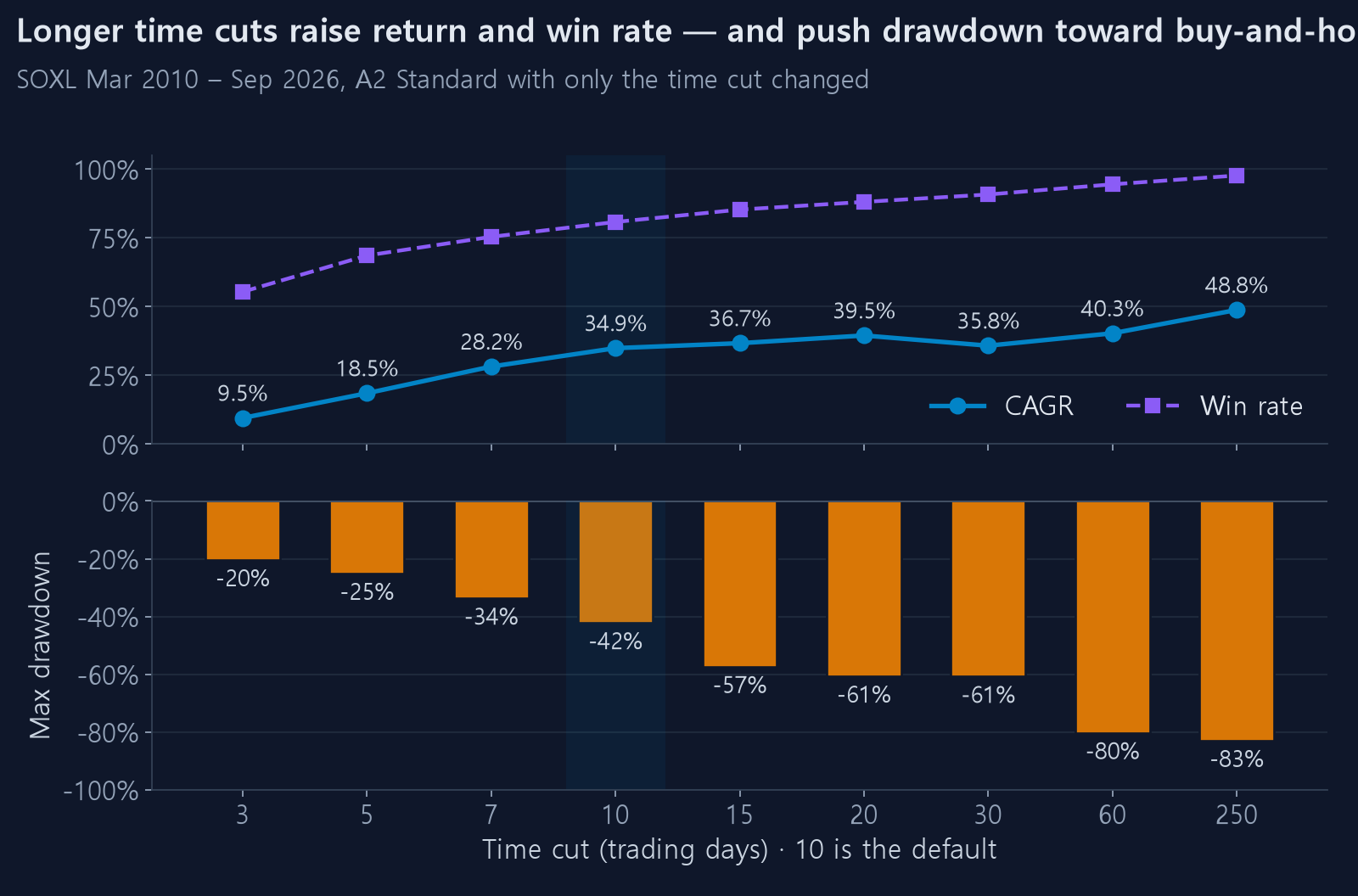
Going from 3 to 250 sessions multiplies the return by 200x and takes the win rate from 55% to 97.7%.
The reason is simple: leveraged ETFs eventually go up. Wait long enough and nearly every tranche reaches its target. Two hundred and fifty sessions is a year, and a 1.5% gain inside a year is almost always available.
2. But the drawdown goes from −20% to −83%
That is the whole story. At a 250-session time cut the maximum drawdown is −83.0%, barely distinguishable from buy and hold at −89.9%.
Remove the time cut and split buying stops being split buying. Tranches never clear, so you end up holding the full position straight through the bear market.
3. A 97.7% win rate that means nothing
At 250 sessions the strategy wins 97.7% of its trades. Ninety-eight times out of a hundred. And the account still falls 83%.
Win rate is not a measure of quality. Lower the target or lengthen the wait and you can push it anywhere you like; the bill always arrives as drawdown.
4. There is a knee between 10 and 20
By return-to-drawdown efficiency, the 7–10 session range is the sweet spot, which is why the default is 10.
Also look at the 30-session row: it returns less than 20 (15,386% against 24,127%). The relationship is not monotonic, which is a warning that these particular numbers carry a lot of luck.
What the time cut is really for
Its job is not to improve any single trade. Its job is to recycle capital.
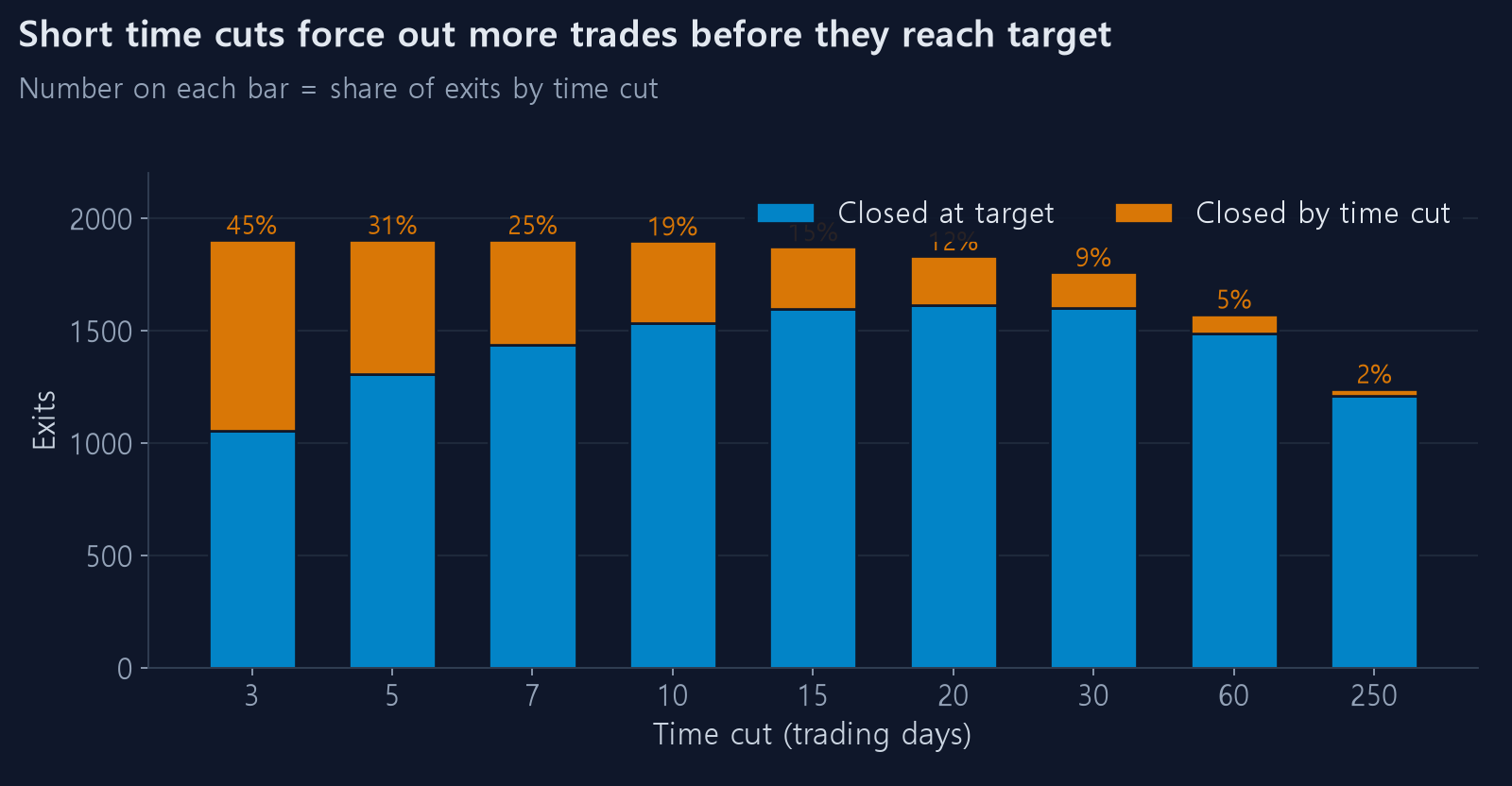
Split buying has a fixed number of tranches — six, in these presets. A tranche that is stuck and unsold keeps its slot occupied, which means one fewer tranche available for the next decline.
The time cut forces that slot open. You take a loss on that tranche, and the freed slot catches the next opportunity. It is a rule about turnover, not about the profit and loss of any individual trade.
That also explains why a 3-session cut comes last on return. Clearing too aggressively turns over quickly but never gives a normal move time to work, so it only accumulates losses.
Practical warnings
Time cuts arrive in clusters
In a decline, tranches fill within days of each other and then hit their time cut together, ten sessions later. You get days where three or four tranches are closed at a loss at once.
In a backtest that is one row. In practice it is the moment most people abandon the rule. The today's orders page shows the time-cut date for every open tranche, so you can see the clusters coming.
Sessions, not calendar days
Ten means ten trading sessions. With weekends and holidays that is roughly two weeks.
It depends on the ticker
The table above is SOXL. On something far calmer like SPY or SCHD, the odds of gaining 1.5% within ten sessions are much lower, so the proportion closed by time cut rises sharply. Change the ticker and you must revisit the time cut.
Run it yourself
On the backtest page, change only "max hold days" in the split-buying parameters box and you can reproduce the table above.
While you do, always read return and maximum drawdown together. Look at return alone and the conclusion is "longer is better" — and following that conclusion all the way lands you back at buy and hold.