Hunt for leveraged products and you will find ETFs and ETNs mixed together. Both trade like stocks and your broker shows them identically. But the way your money can disappear is different.
The one-line difference
An ETF is a fund that actually owns things. The manager buys stocks or derivatives and holds them. If the manager goes bankrupt, those assets sit in a trust and come back to investors.
An ETN is an IOU written by a bank. It is a note promising to pay whatever the index returns. The issuer is not obliged to hold anything at all. If the bank fails, the promise fails with it.
| ETF | ETN | |
|---|---|---|
| Legal form | Fund (holds assets) | Unsecured debt (a promise) |
| If the issuer fails | Assets remain | Total loss possible |
| Tracking error | Present | Almost none |
| Early redemption | Rare | At the issuer's discretion |
| Maturity | None | Usually has one |
What actually happened
In February 2025 Bank of Montreal announced it would redeem the entire FNGU note, a popular 3x product tracking large technology stocks.
The sequence was:
- February 2025 — redemption announced
- March 2025 — ticker changed from FNGU to FNGA
- 15 May 2025 — redeemed and delisted from the NYSE
- Afterwards — a new note began using the FNGU ticker again
From the holder's side, a product that was working fine was converted to cash on a date somebody else chose. Anyone sitting on a loss had no chance to wait it out.
There is no way to prevent this. The issuer decides. ETFs almost never do this.
Why this is worse for backtesting
The FNGU story has a second trap: a different note now trades under the same ticker.
Price vendors usually stitch history together by ticker. So the old FNGU (2018–2025) and the new FNGU (2025 onward) can arrive as one continuous series even though they are separate instruments.
Run a backtest on that and you get a phantom gap at the 2025 boundary. Every return and drawdown figure computed across it is meaningless.
That is why FNGU is not on this site's ticker list. Having data is not the same as having usable data.
The ETNs currently on this site
| Ticker | Type | Listed | What to check |
|---|---|---|---|
| SPYU | ETN | 2023-12 | Barely two years of history. Traded as XXXX before May 2024. Issuer is BMO |
| GDXU | ETN | 2020-12 | Five years, almost all of it a gold bull market. Same MicroSectors family as FNGU |
| SOXL, TQQQ, UPRO, TECL, KORU, UDOW, TMF | ETF | 2009–2013 | No issuer credit risk |
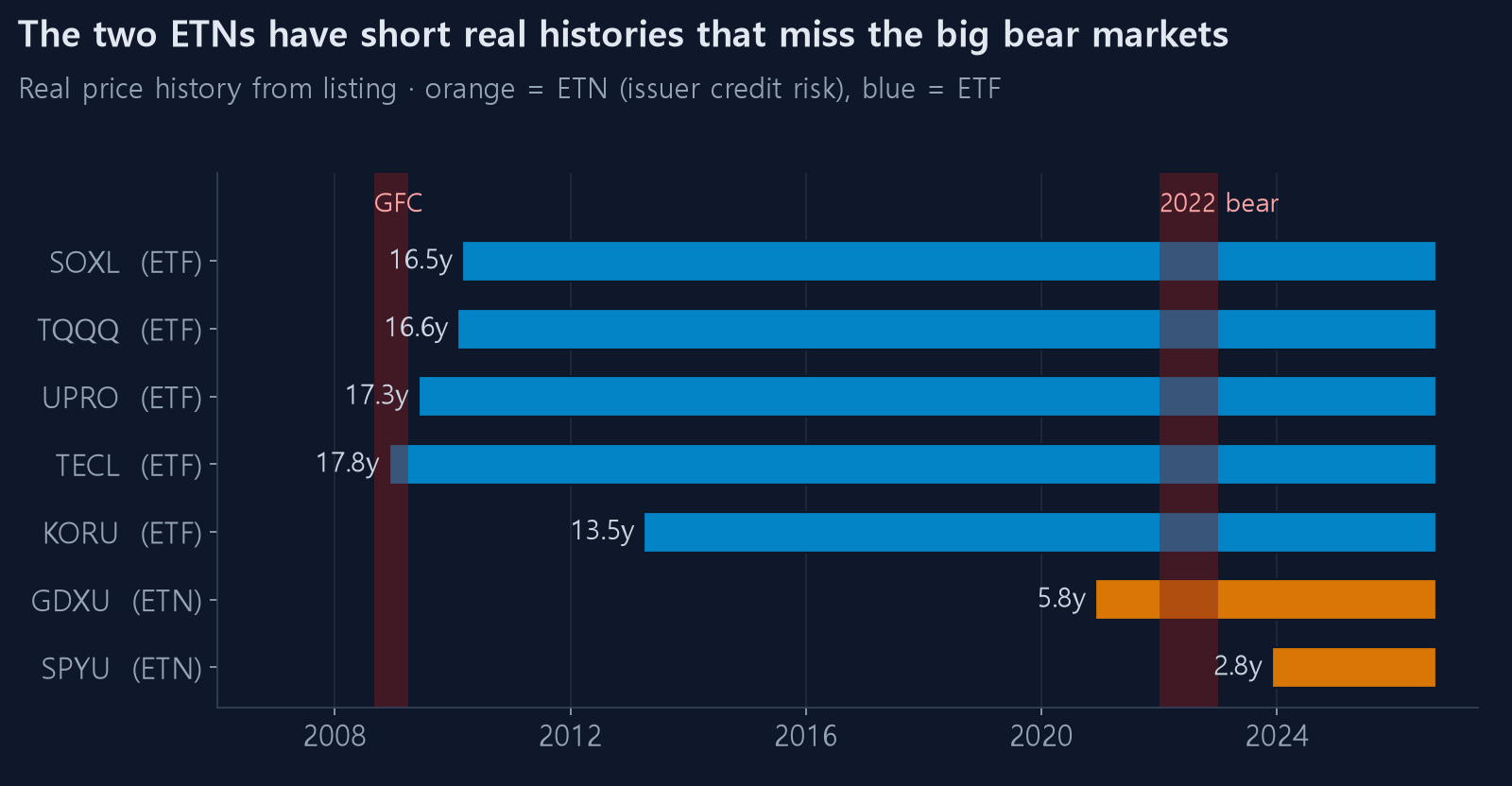
Select an ETN on this site and a warning appears alongside it.
Why anyone uses ETNs anyway
They are not all downside.
Tracking is near-perfect. An ETF has to buy and sell real assets to follow its index and drifts slightly. An ETN settles by formula, so it sticks to the index exactly.
Some products only exist as notes. Four-times leverage or an unusual index is hard to package as a fund. SPYU is one example.
Tax treatment can differ. It depends on your country and account type, so check before assuming.
Before you buy
- [ ] Is it an ETF or an ETN? The first line of the fact sheet says so
- [ ] If an ETN, who is the issuer, and have they redeemed products early before?
- [ ] Is there a maturity date, and when?
- [ ] Has the ticker ever changed? Your backtest data may be two products stitched together
- [ ] When did it list? Nothing before that date can be tested
Leveraged products are risky on their own. Whether it is worth stacking issuer credit risk on top is a fair question to ask yourself. If an ETF tracks the same index, it is usually the safer wrapper.
Read how volatility drag eats leveraged returns next — it explains why holding these for long stretches is harder than it looks.