Once you have decided to average down, the next question is how much goes in each time. More feels better. The data says close to the opposite.
How it was compared
The seed was fixed at $10,000 and only the top-up amount changed, with up to five accounts.
| Top-up | Maximum total | Seed as share |
|---|---|---|
| $10,000 (100% of seed) | $50,000 | 20% |
| $5,000 (50%) | $30,000 | 33% |
| $2,500 (25%) | $20,000 | 50% |
Seven tickers — SOXL, TQQQ, SOXX, UPRO, TECL, KORU, TMF — over 2011 to 2026, with forty combinations of drawdown trigger, account count and trigger basis run for each.
You keep 68% of the benefit and 14% of the downside
Halving the top-up does not halve the benefit.
$10,000 top-up   return improvement +5.09pp
 $5,000 top-up   return improvement +3.66pp   (72% retained)
 $2,500 top-up   return improvement +2.44pp   (48% retained)
But the extra money lost in losing years falls far faster.
$10,000 top-up   -$12,552
 $5,000 top-up    -$4,932   (39%)
 $2,500 top-up    -$1,820   (14.5%)
Expressed as benefit per unit of risk, the gap is stark.
| Top-up | Improvement | Loss in bad years | Improvement per $1,000 |
|---|---|---|---|
| $10,000 | +7.41pp | −$12,552 | 0.59pp |
| $5,000 | +5.21pp | −$4,932 | 1.06pp |
| $2,500 | +3.62pp | −$1,820 | 1.99pp |
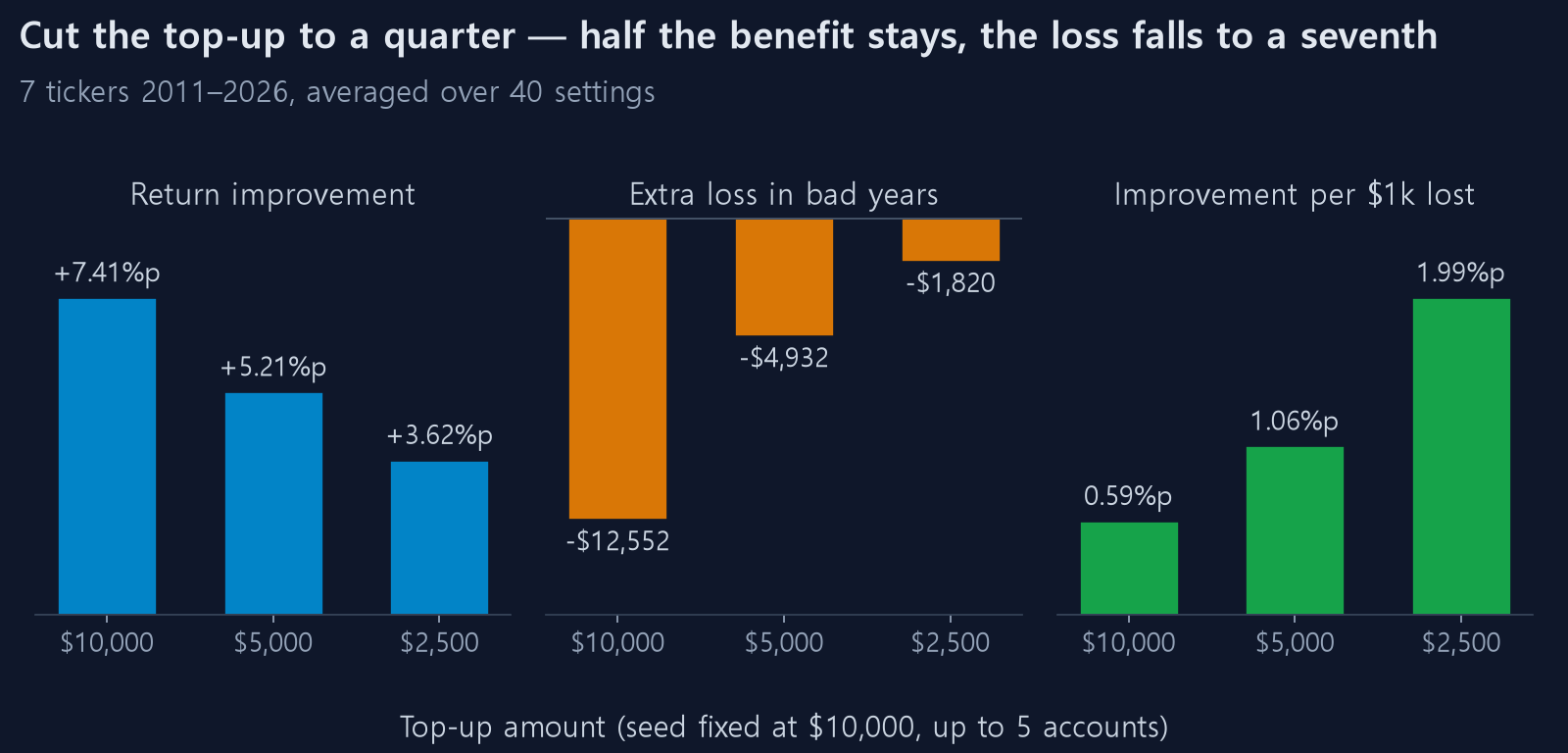
For the same amount of pain, you get 3.4 times the improvement.
Where capital efficiency stops improving
Measured as improvement per $10,000 deployed:
$10,000 top-up   max total $50,000   +1.02pp
 $5,000 top-up   max total $30,000   +1.22pp
 $2,500 top-up   max total $20,000   +1.22pp   ← identical
Efficiency rose from $10,000 to $5,000 and then stopped. That is the plateau. Going smaller does not make each dollar work harder.
The reason to prefer $2,500 anyway is that efficiency holds while risk keeps falling.
Why it works this way
Shrinking the top-up means the seed becomes a larger share of the total. At $10,000 top-ups the seed is 20% of everything; at $2,500 it is 50%.
Money that arrives late is doubly disadvantaged: it compounds for less time, and in a bad year it simply adds to the loss. A large opening position with small top-ups beats a small opening position with large top-ups.
Going smaller than this
Below $2,500 the whole-share constraint bites.
A $2,500 top-up split six ways allocates $417 per tranche. At a $120 share that is three shares; as the price rises it becomes one or two, and on an expensive instrument it becomes none. The effect simply evaporates.
Since efficiency has already plateaued, this is the place to stop.
One more thing
At $2,500, all seven tickers finished positive. TMF had lost money at both larger amounts and turned around here.
TMF -$1,307 → -$372 → +$157
That was the first setting where no instrument lost money.
Summary
- A top-up of roughly 25% of the seed gave the best risk-adjusted result
- Capital efficiency stops improving below about 50% of the seed
- Smaller is still preferable because the bad-year loss keeps shrinking
- Below 25% the whole-share constraint erases the effect
These are past figures for seven tickers over 2011–2026. They guarantee nothing. See also does averaging down work.