Note — strategy names such as S2 in this article are from the time of the research and are no longer in the site's strategy list (A, D, B, G and I families). See the strategy guide for the current ones.
Buying more after a loss to lower your average cost is called averaging down. It is common advice, and there is very little data showing whether it helps.
Here is what the averaging-down simulation on this site produced across seven tickers over sixteen years.
How it was tested
The rule: run a strategy, and when the account falls by a set amount, add capital and start the same strategy in a new account. We combined five drawdown triggers (−10%, −15%, −20%, −25%, −30%), two to five maximum accounts, and two trigger bases — forty combinations, each run in full.
Tickers: SOXL, TQQQ, SOXX, UPRO, TECL, KORU and TMF, 2011–2026.
The percentage improves
The best combination was a −10% trigger with up to five accounts. Returns improved on all seven tickers, by more than five percentage points on average.
Stop here and averaging down works.
But the money lost grows
Filter the same data to the years where the base strategy ended negative and the picture inverts.
The return percentage improves by more than seven points, while the actual money lost gets larger. The percentage improved not because losses shrank but because the denominator grew.
In numbers:
| Capital | Loss % | Money lost | |
|---|---|---|---|
| No averaging down | $10,000 | −16% | −$1,600 |
| Averaging down (5 accounts) | $50,000 | −11% | −$5,500 |
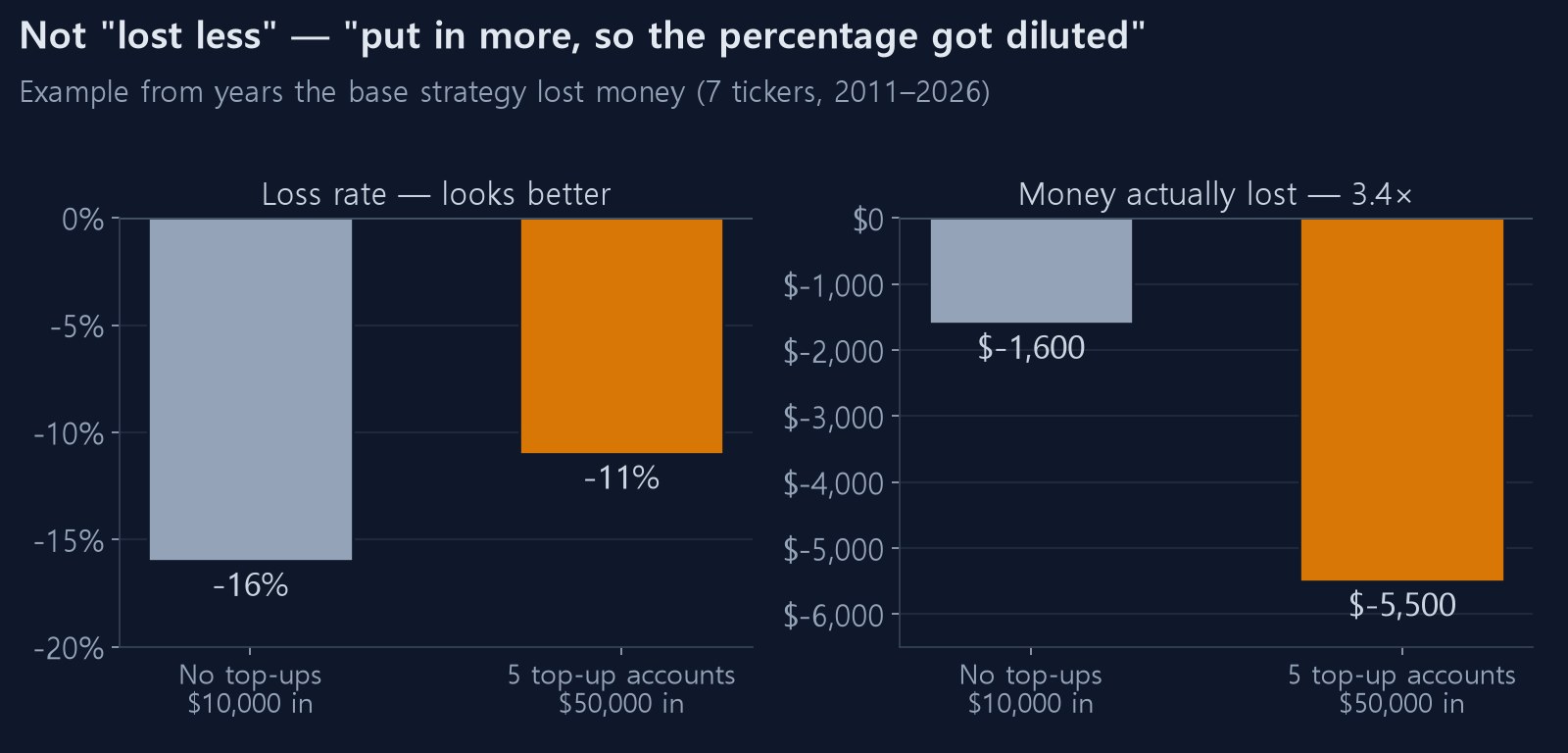
The loss percentage improved by five points and the money lost is 3.4x larger.
That is not "lost less". That is "committed more, so the ratio diluted."
How that illusion works is set out in three ways to measure return. Change the denominator and you can make a percentage say almost anything.
Drawdown barely improves either
Splitting into several accounts improves maximum drawdown by roughly one percentage point.
The reason is simple. Running the same strategy on the same ticker with only a time offset produces almost identical equity curves. There is no diversification. Measured directly, two accounts' drawdowns track within 0.1 of a point of each other.
Compare that with diversification that actually works. The S2 ensemble from our earlier research mixed three strategies of genuinely different character, their correlations dropped to 0.28, and the combined volatility came out 2.4 percentage points below the simple weighted average (how ensembles reduce drawdown).
Cloning one strategy with a time offset is not diversification. The correlation is near 1, so nothing cancels.
And in money terms the drawdown is far larger: −35% of $10,000 is $3,500, while −33% of $50,000 is $16,000.
Check the worst case before anything else
The real danger of averaging down is in the tail, not the average.
A setting that allows five accounts means the entire capital is committed after five consecutive −10% steps. If the market keeps falling from there, no cash remains. A year like 2022, grinding down for twelve months, produces exactly that.
In the backtest a rebound eventually arrives and it recovers. In practice the question is whether you can fund the additions while waiting. Plan averaging down only after confirming the money genuinely exists.
When does it make sense?
Under one condition: when the total you intend to commit is already fixed.
If you plan to deploy $50,000, the question is not "should I average down" but "should I deploy $50,000 at once, or in pieces?" Compared at the same total, deploying in pieces won, because the later money bought at lower prices.
That is why the averaging-down output on this site includes a "full amount from the start" row. Comparing against the base strategy alone is unfair, since the capital differs. Always read it against the "full amount from the start" row.
What trigger level?
The top of the forty combinations was entirely −10% and −15%. The −25% and −30% triggers almost never fired, producing results identical to the base strategy.
But read that carefully. It does not mean "shallow and frequent is better". It means "in US markets from 2011 to 2026, −10% dips were common and mostly recovered." In a market that does not recover, a shallow trigger exhausts your capital faster.
Summary
- The return percentage improves, largely through a bigger denominator
- In losing years the money lost grows
- Drawdown barely improves, because cloning a strategy is not diversification
- With a fixed total, deploying in pieces beat deploying at once
- Confirm what happens when the full amount is committed, first
Treating averaging down as a safety device is dangerous. It is closer to committing more money to dilute a ratio.
None of these figures guarantee anything about any ticker's future. Change the settings and check for yourself — the 💧 averaging-down button on the backtest page can load SOXL windows that ended negative directly.